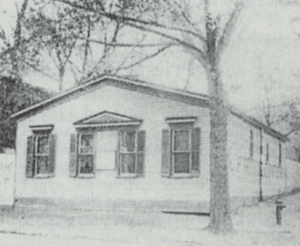


P.S. 113 had a cinder schoolyard without a fence. When the school janitor took out the ashes, he would dump them in the schoolyard and rake it in.
Durow’s was once called Koenig’s, before that it was Happy’s, and before that it was Ral1’s 19th Hole. It had a night club atmosphere with a live band for dancing on weekends. Speaking of dancing, Sacred Heart had two basketball games, with dancing to Jimmy Lambert and his band, before the game, at halftime, and after the games, until 11 p.m. on Sundays. The cost was 35 cents a person – Father Wally Missbach coached our first basketball champion team.
In front of Sacred Heart Rectory there was a nice gold fishpond, with a large working lighthouse in the center. It was located where the Abortion Memorial is today. There were minstrel shows in the basement of the church – a precursor of the great Theatre Guild shows to come decades later. At the time Jake Kossmann was president of the Senior Holy Name Society, and Rose Warneck was then president of the Altar Society, and Ray Ewen was Mr. Everything in Sacred Heart Sports.
Along Myrtle Avenue, where the American Legion Hall is located today, there was an Honor Roll with the names of all the Glendale men and women who served in World War II.
Wehman’s Ice Cream Parlor was the local hangout for all the teenagers. It was located at Myrtle Avenue and 79th Street. The name of our parish has proved most fitting, because the parish community then, as it remains today, is a giving, loving, openhearted, and compassionate group of people.
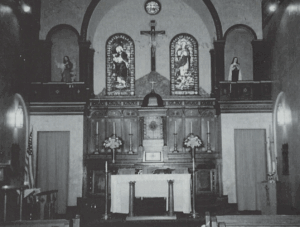
Another interesting note: the large crucifix that hangs above the altar was the original crucifix from 1929 that hung on a wall in the dance hall. The stained glasses above the altar on either side of the crucifix were obtained for Fr. Sherman by Mr. George Fox, who was in the wrecking business and was in the process of tearing down a church in Brooklyn. He also obtained our Stations of the Cross.
On May 3, 1935, ground was broken for the rectory (that contract was awarded to the Masem Construction Company). The building was completed on November 8, 1935, and occupied on November 11. Ground was broken for a school on May 31, 1940, and the cornerstone was laid on April 23 of the following year and the building completed in 1941. Six Sisters of St. Dominic (Dominicans) taught the children, the first principal being Sr. George Dominic. Initially the Sisters resided in two converted homes on 85th Street near 78th Avenue. As the parish continued to grow, plans were drawn for a new convent to accommodate the anticipated additional teaching staff. It was completed in 1951.
School classes began in September 1941 for grades 1 through 5; the “graduating” class of 1945 numbered 26. There was a mandatory 9 o’clock children’s Mass every Sunday. When attendance was taken in the classroom on Monday morning, children had to announce ‘Mass and Communion” (or perhaps just “Mass,” heaven help them). But it was good. Father Sherman addressed the students every Monday. There was a boy’s glee club, a girl’s choir, Christmas plays, open school days, the annual parade of “saints” in full, homemade costume around the blocks, the annual parish Bazaar in the school gym, and a special children’s afternoon. In the parish “history” book of 1979, on the occasion of our Golden Jubilee, it was noted that in the early years, altar boys were “under the intense scrutiny” of Father Missbach. The children jumped rope with Sister Mary Claver, and who among the oldies can forget the May Crownings – still done today.
Special mention should be given the very first lay teacher of the school: parishioner Mrs. Claire Bowler, who taught third grade from 1954 until her retirement in 1967. Not far behind her was Mrs. Charlotte Rampolla, another parish member. (A full listing of lay staff is found later in these pages). The Home School Association was launched around this time, moderated by Fr. John Stolz.
The family community of Sacred Heart, as indeed families everywhere in the postwar years, made many significant sacrifices to sustain the parish plant, while ensuring a quality Catholic education for their children. For generations it seems, the first-grade classroom on the ground level overlooking 84th Street was presided over by the beloved, diminutive Sister Petra (aunt of parishioner Greg Geis). She celebrated her golden jubilee in 1968 and retired from teaching the following year. She remained in residence until her death in 1982.
In the parish’s early years, women were notably prominent. Anne Plante was the first church organist and served for many years. (Ms. Plante was also very active in volunteer and charitable efforts on behalf of St. Rose of Lima Cancer Hospital.) Then Rita Fuchs served “on the bench” for many years as well. Under both women, there were large adult choirs.
Some parishioners have shared special memories of Father Sherman. To a woman who suffered a miscarriage, he paid a personal home visitation and delivered a beautiful 30- inch tall statue of the Sacred Heart, to whom the woman had great devotion. She passed away in December 2002, and the now 63-year old statue remains in her home. Another parishioner recalls paying frequent visits to church and “often, on the left side of the sanctuary (the tabernacle was in the center at the time) would sit an elderly man, gazing at the tabernacle. He held no book, he moved not at all. He sat quietly, contentedly, peacefully, absorbed in attending to his God behind the little door.” The man was Father Sherman. Still another remembers Father Sherman “standing in front of church on Sunday at five minutes before 10 a.m. and telling people to hurry up into church because they were late for Mass.” Although Father Sherman was of German heritage, he spoke with a bit of an Irish brogue, thus appealing to both the German and Irish in the parish.
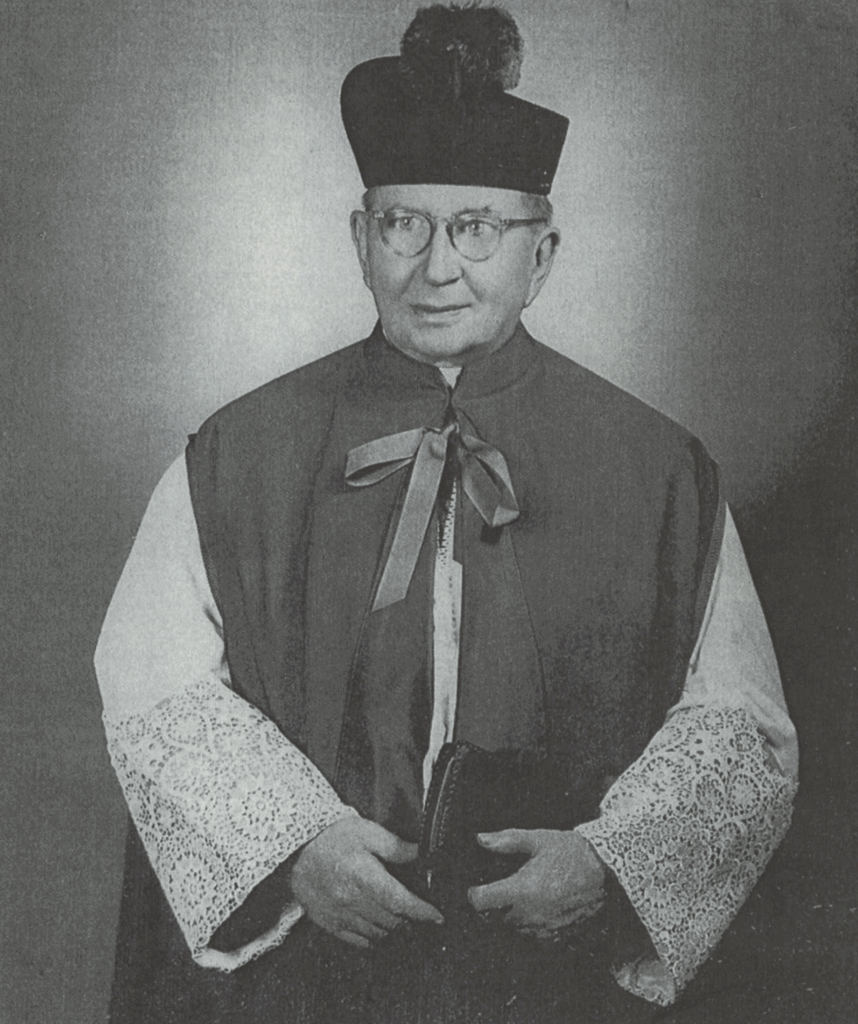
Twenty-five years after the humble beginnings of the parish, in May 1954, our founding pastor was appointed a Domestic Prelate by Pope Pius XII (the formal title is Right Reverend Monsignor). Less than three years later, on April 29, 1957, he passed away after undergoing surgery. “Father” Sherman (he eschewed “Monsignor”) was loved by all. He was a shepherd totally devoted to his flock. By this point in time, there was one other priest on staff: Father Robert Kennedy, who was soon joined by another.
Our second pastor was Msgr. Francis X. Broschart, who would serve for the next decade. During his tenure, and under his direction, an annex was added to the school (whose population had burgeoned by then). During his tenure, parish activities expanded further. In particular, a large and active sports program was created for the parish’s young people, as well as the first Boy Scout troop. In addition, the first church renovation was undertaken. Father Broschart hired Fay Spano to take care of the altar linens and purificators. She also was the rectory cook, three nights per week, in the 1960’s and 70’s. Marie Garfield was the other cook. There was a housekeeper named Teresa, and a husband and wife, Tilly and Gus Kalberer, who, respectively, were secretary and custodian.
Q Msgr. Broschart retired in 1966 and was succeeded by Father Thomas Swarbrick, who remained until his death in 1971. During these years, a Parish Council was formed, a Seniors Guild, a homeless shelter in the church basement, and a Theatre Guild (brainchild of our beloved “Father Tom” (Hendel). The Guild performed from 1967 until the mid-to-late 1980’s offering professional-quality Broadway shows every fall. The “debut” was “Oklahoma!” 19 Others included “South Pacific,” “Fiddler on the Roof” and “Hello, Dolly” (starring Patricia Kossmann). The Guild also sponsored a fun-filled “Irish Night” (show/dance) every St. Pa Patrick’s Day. Among the actors and crew members were Fred Kast, Jack Preis, Richard Oftring, Kieran Larkin, William Gurnee, Patricia Kossmann, Jerry Kossmann, Lillian and Charles Femmel, Ann Paulson, Margaret Paulson, Joe Rovtar, Madeline Horvath, Joan H Farley, Jim Jones, Carol Zwerenz, Patricia (Pihowicz) Warren, Angie Cesark, and Jovana R Ducroiset who painted all the sets and scenery, as well as designed the playbill covers. These are but a handful of the dozens and dozens of parishioners, in addition to a handful of non- parishioners residing in Glendale.
A major fund-raiser for many years in the mid-fifties through the sixties was the annual parish bazaar, held on two November weekends in the school auditorium. There were some serious prizes at booths that featured appliances, electronics, etc. There was also a Ma turkey booth, a liquor booth, and several gaming booths. Many dedicated men and women parishioners, under the leadership of Mae Schreiber, donated hours of “labor” time. Those reins were eventually taken up by Rita and Bill Toth.
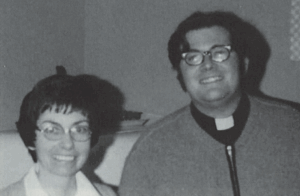
The religious education program has always been one of the parish priorities. The first coordinator was Sister Catherine Thornton, O.P., who was soon joined by the newly arrived curate, Father John E. Mahoney. Together they developed a program to address all religious education needs. Father Thomas Hendel spearheaded the relocation of the religious education office to the convent basement, and upon her arrival, Sr. Margaret directed the R.C.I.A. program from there. (The religious education office is now in the school and is under the direction of our current pastor, Fr. Fullum). The programs included Little Christian School, elementary CCD, Junior High CCD, and Special Education. There are trained catechists who conduct the instruction programs for first Penance, first Communion, and Confirmation. It should be especially noted that success of any program is due in large measure to the dedicated labors of many lay volunteers.
 These were the post-Vatican II years, and in the wake of the Council, the parish gradually adopted the prescribed changes. The altar was changed to face the people, its rails removed, the Tabernacle was relocated, confessionals were redone, and so on. (A side note: originally, there were four confessionals in church! The two in the rear were converted into the shrines we have today.)
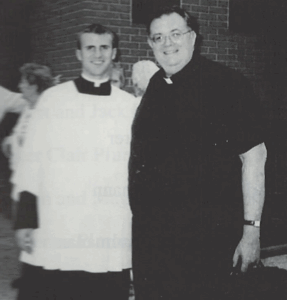
By the mid-seventies, there were almost 6,000 registered parishioners. The pastor at the time was Father John Hartman. During his tenure, the Homeless Shelter was born; and he was a strong supporter and advocate of this special outreach in our parish. One parishioner recalls a personal home visitation he made on the evening of her brother’s death, staying for hours to offer compassionate words – and just his presence. Father was made a Monsignor in 1988 and served until his retirement in January 1998 at which time we welcomed and a installed our current pastor, Father John Fullum (a transplant from our neighboring parish, St. t. Pancras). Father Fullum, likewise, has been a major supporter of the Shelter as well as other d ministries. Parishioners enjoy his sense of d humor and recognize his dedication to Sacred Heart. After the previous (lay) Director of a Religious Education departed, he assumed that responsibility himself.
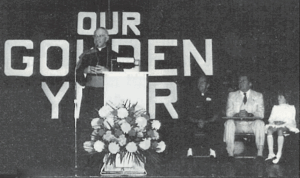
The parish celebrated its 50th anniversary in 1979, marked by a variety of spiritual, liturgical, and social activities throughout the jubilee year. The Anniversary Mass on Sunday, June 10, was concelebrated by Bishop Francis Mugavero. This was followed by a reception in the school hall. Later in the month, on Friday, June 22, 770 parishioners, former parishioners and friends attended the formal banquet dinner at Terrace on the Park. It was in all respects a spectacular evening.
We were also richly blessed in the 1980’s and early 1990’s with the ministry of Deacon Walter Nonnenman. His sudden death shocked and grieved all parishioners. Today, we are again blessed in the person of newly ordained Deacon Peter Stamm, a lifetime parishioner.
 Many organizations flourished until the 1980’s. Among them were the Rosary Altar Society, the Holy Name Society, and the Parish Council – all have slowly dissolved (at least formally speaking), due to a number of factors.
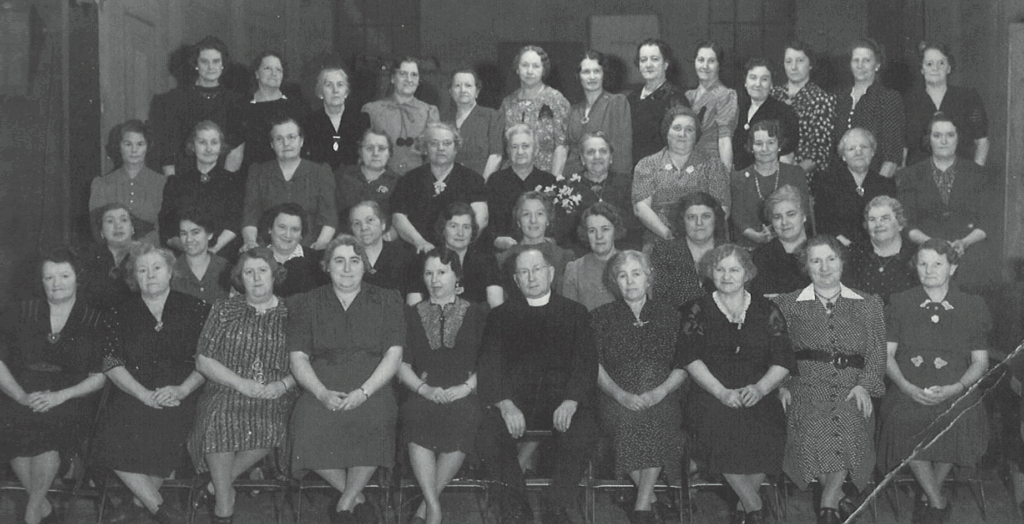
The Rosary Altar Society was a merger of two earlier women’s organizations: the Altar Society (who handled and took care of the altar linens), the Rosary Society (fostering devotion to Mary and gathering at Monday evening novenas followed by recitation of the rosary). The Society soon became a major fund-raising source for the parish, sponsoring various activities, among which were card parties and the annual Mother-Daughter Communion breakfast.
The Holy Name Society was the first organization; and, as its name suggests, its purpose (membership was male) was to foster reverence and devotion to the Holy Name of Jesus in all aspects of daily life. They sponsored the annual Father-Son Communion Breakfast, which in later years became the Family Communion Breakfast, as well as an annual parade through Glendale and many social activities. But of great importance to its members was the annual retreat at the Passionist Monastery in Jamaica Estates. However, membership declined in later years. But members resurrected as ushers, St. Vincent de Paul Society volunteers, Nocturnal Adoration Society members and organizers of the Msgr. Sherman Council of the Knights of Columbus.
The Parish Council was begun in large part as a response to Pope John XXIII’s recommendations at the Second Vatican Council. Members ranged in age from teens to seniors and met on a monthly basis. After more than a dozen or so years, it too fell into demise.
In preparation for the upcoming Diamond Jubilee, the church has undergone very significant refurbishing, beginning in early summer, 2003 and finishing in September. Masses were celebrated during that period in the church basement. The floors and benches were scraped and refinished, new kneelers installed and new carpeting. The walls were cleaned, the radiators painted and the ceiling redesigned (with gilded work) by a gifted Russian artist (see accompanying photographs). The new church organ was also purchased around this time.
 In this our 75th year, parish enrollment shows a marked decline from the previous decade of close to 2000 families. Today that number is under 1600 families (roughly, 3000 regular congregants). Since attendance at Mass has waned, there have been schedule changes for Masses and other liturgical events. Still, we who come together for regular worship and play, remain a vibrant and faith-filled community.
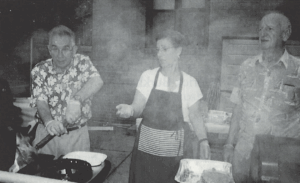 The anniversary year was launched with a special Mass on the Feast of the Epiphany in January. Throughout the calendar year, banners have been on display depicting the 12 Promises of the Sacred Heart to St. Margaret Mary Alacoque.
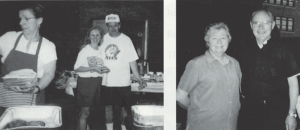

The 75th anniversary parish Mass was celebrated on Friday evening, June 19, followed by a huge barbecue in the meadow outside. Unfortunately, our pastor, Fr. Fullum, could not attend, as he was abed with a serious infection and fever. He remarked that he watched the Mass from the rectory’s closed-circuit TV. As this Memory Book goes to press, final plans are underway for the formal dinner-dance to be held on Friday evening; November 5, 2004, at Russo’s on the Bay.
So, we have indeed come a long way. As the anniversary theme so tellingly proclaims, the heart does live on generation after generation!
Marion Amling
Augustus and Matilda Kalberer
Harriet Betcher
Abby and Christopher Kaufmann
Ralph Bower
Mr. and Mrs. Christopher Kaulmanan
Richard and Frieda Bower
Rosa and Sophie Kluepfel
Pauline and Frederick Burkhardt
Emma and Joseph Kossmann, and Family
Rita Mack Chomas
Edward Kovacs, Jr.
Bernadette (Metzler) Conrad
Wanda and Edward Kovacs
Leo Conrad
Wanda (Kovacs) Lawrence
Anthony Fazio
Joseph Mack
Carol and Edwin Fuertinger
Sophie and John Mack
Mr. and Mrs. Frank Gander
Mildren (Ewen) McConkey
Catherine and Ottmer Green
Mrs. Thomas McConkey
Clifford and Evelyn Green
Frank, Mary, Anna, Caroline,
John, and Francis Miller
Father Edward Gorry (Paulist)
Anna and Louis Mock
Mr. and Mrs. George Harvey
Betty, Emma, and
Eva and Nicholas Hoffmann
Barbara (Morisse) Mock
Elizabeth Hohl
Catherine and Hugh A. Mulligan
Anna and Carl Hummel
Raymond, Edward, Eugene,
Rosemary (Walsh) and
Margaret (Riedell) Mulligan
Marie (Wenzler) Iadanza
Grace Stolzenberger Olander
Anna and Valentine Sax
John and Elizabeth Preis
Alfred Schneider
Robert and Jack Preis
Anna (Burger) and Philip Schurr
Sister Clair Pfundstein, O.P.
Elinore Shaeffer (Weber)
Joseph and Magdalan Pfundstein
Joan Siegal
Adrienne Plumeau
Mrs. Loretta Siegal
Gertrude and Anthony Rienecker
Rose and Charles Smith

Maria and Joseph Ringswald
Max and Elizabeth Stamm
Henry L. and Anna E. Steskel
Eleanor and Howard Tilley
Marco and Claudia Troiano
Joseph and Aloisia Tscherne
Joan Von Rekowsky
Rose Warneck
The Wirsching Family
Fred A., Rose and Frederick L. Ringswald
William, Andrew, Joseph,
Louis, and Elsie Ringswald
Bertha Stampfli Roessler
Mary and Frank Ryan